Good Friday: Prayer Stations 3: Liquid WorshipLiquid Worship
Traditional worship is linear - it starts at the beginning and follows a structured service through to the end. Liquid Worship is different; instead of being linear, there are stations or zones set up around the church for people to visit. The congregation can choose how they spend their time - for example they can spend all their time at one or two stations or visit all of the stations in any order they please.
The stations may include reflecting on readings, listening to music, taking part in actions, or art and craft activities.
Liquid Worship can work well with different age groups with material provided at many different levels. Good Friday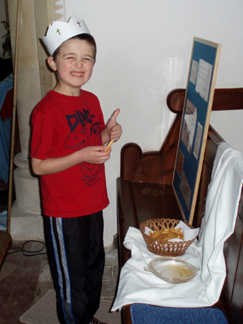 Our Good Friday service was offered as an alternative to the traditional Good Friday meditation. As it was expected that children would come with their families, it needed to work at both adult and child levels. We had more stations than in previous Liquid Worship services, but the stations themselves were simpler. As before, we began with the story in order to provide a context for the stations. We retold the series of events from Jesus' arrest in the Garden of Gethsemane to the placing of his body in the tomb. It included Jesus' trial before Pilate, the taunting by the soldiers, the whipping and the crucifixion itself. At the end of the service we came back together to sing "There is a green hill far away". As this might have been the only Easter service for many of the congregation the leader spoke briefly about the resurrection, and we finished by singing "He's got the whole world in his hands", a song well known to the children, but also one that focussed on God's power. The stationsWe wanted the congregation to reflect on the different events of Good Friday - from Pilate washing his hands to Jesus' body being laid in the tomb. Around the church we had a selection of pictures of the crucifixion and words to help reflection. 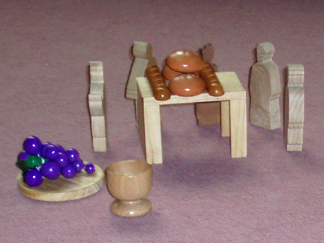
Station 1: Holy WeekIn the north transept we laid out the wooden figures of Jesus and his disciples at the Last Supper, with baskets of wooden grapes and bread, cups and pattens. We also had the model of Jerusalem, a wooden figure of Jesus on the donkey and a selection of felt cloaks and plastic "palms" for the story of the entry into Jerusalem. A collection of Bible story books were displayed, telling the story of Holy Week. 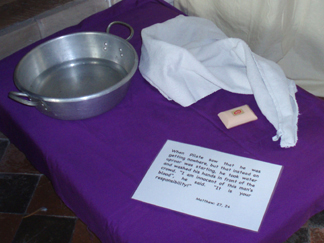 Station 2: Jesus before PilateWe had a bowl of water with a towel and soap. The accompanying text was Matthew's account of Pontius Pilate washing his hands of Jesus. 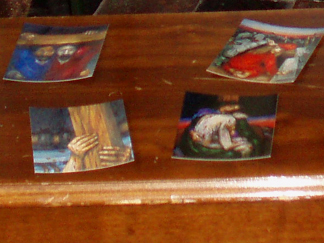 Station 3: The road to GolgothaWe laid out a series of postcards depicting the stations of the cross. Paper and pastels were provided for those who wanted to make their own picture of one of the stations. A leader manned this station and the congregation was given the opportunity to ask questions, take part in discussion or find out more about the story. 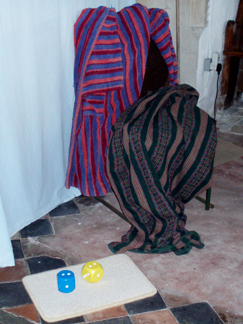 Station 4: The soldiersClothes and large dice reminded everyone that the soldiers gambled for Jesus' clothes. Station 5: "I thirst"This station reflected on the time when Jesus said, "I thirst" and was offered a sponge soaked in vinegar. A sponge was tied onto a spear. We also had breadsticks and a bowl of vinegar - the congregation were invited to use the breadsticks to sample the vinegar. 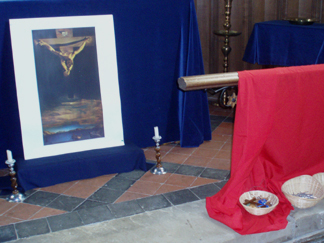 Station 6: The CrucifixionSalvador Dali's picture of the Crucifixion (Christ of Saint John of the Cross) was placed by the altar rail. A basket with a selection of crosses was nearby, and the congregation were also given the opportunity to make their own crosses out of nails. 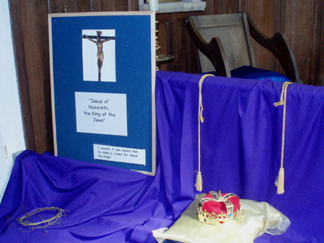 Station 7: King of the JewsOn the other side of the altar rail we had a picture of Jesus on the cross with the caption INRI "Jesus of Nazareth, the King of the Jews". A king's crown on a cushion was contrasted with a crown of thorns. The children were invited to make crowns for Jesus the King, using Christian symbols and pictures. 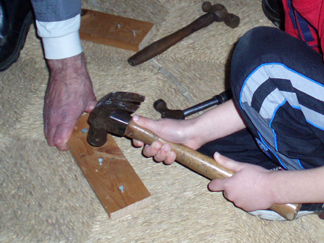 Station 8: Death on the crossWe set up a place at the back of the church for the congregation to hammer nails into wood. This station was manned and we asked children to have a parent or carer with them. We had a picture of Jesus dying on the cross and words to reflect on the pain of the crucifixion. 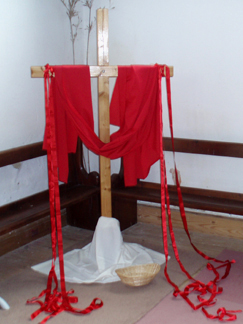 Station 9: Praying at the crossWe invited people to write a prayer on a cross shape and place it in a basket at the foot of the cross. We draped the cross with red material and ribbons as we had done for Experience Easter. At this station we also had a basket of different crosses and a wooden cross puzzle to be put together. 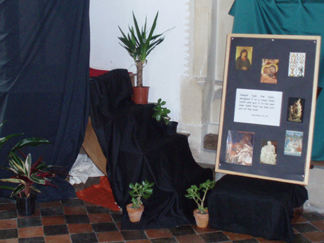 Station 10: The tombWe created a tomb under the pulpit by draping the pulpit with black material. Green plants were placed in front and on the pulpit steps. Under the steps we laid the cloths and scented them with rosemary (as myrrh is quite expensive!) 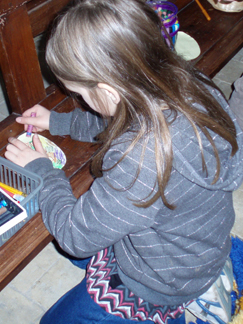 Station 11: What next?At the back of the church we had baskets of Easter eggs, with the words of the Godly Play story for Easter Day. There were egg shapes for the children to decorate. We included this station as we wanted to complete the story for those who would not be going to church at Easter. How well did it work?At first the children rushed around unable to settle; it looked as if all the material would be exhausted in 5 minutes. Then, suddenly, they were all involved, making crosses, banging in nails, sampling wine vinegar, colouring eggs, making crowns. Before the event, I was not sure about having someone sitting with the postcards of the stations of the cross to tell stories; in the event this worked extremely well. One of the 10 year olds had a series of questions about the events of Holy Week, and needed someone static with time to listen to him. It also worked well with a family of mixed teens and small children, who wanted more detail than the storytelling at the start of the service. What would we have changed?We felt this service worked particularly well and offered a good variety of activities. A station that we did not include (partly because I couldn't find the snake!) was a sand box with figures of the snake and Adam and Eve to link back to the original fall. Sarah |